Revenue leakage in medical practices is rarely random. It usually occurs at specific, predictable points in the revenue cycle, regardless of a practice’s size, speciality, or billing model.
The good news is that these patterns make revenue loss easier to identify and prevent. Understanding where your revenue cycle management process loses revenue provides a clear roadmap for improving collections and protecting your practice’s financial performance.
In this guide, we’ll look at the five stages where practices lose the most revenue and what a prevention-focused approach looks like at each step.
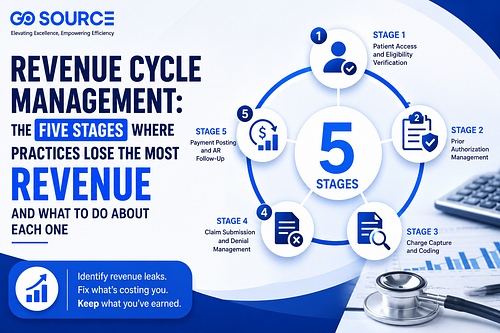
Stage 1: Patient Access and Eligibility Verification
The revenue cycle starts when a patient schedules an appointment, and one of the most common revenue losses begins here.
If insurance coverage is not verified in real time before the visit, or rechecked on the day of service, coverage changes, expired plans, and benefit limitations can go unnoticed until the claim is denied.
Eligibility denials are among the most preventable in medical billing. Verifying coverage at every patient encounter, rather than relying on previous visits or periodic checks, helps eliminate most of these avoidable denials.
Stage 2: Prior Authorization Management
Prior authorization is one of the few stages where missed revenue can become permanent.
When a service that requires prior authorization is performed without approval, the resulting denial is often impossible to recover, regardless of how efficiently the billing team handles it. In many cases, retrospective authorization is unavailable, and delaying treatment after the service has already been delivered is not an option.
The real loss is not just the denied claim. It is revenue that was earned through patient care but cannot be collected because an authorization requirement was missed before the appointment.
Stage 3: Charge Capture and Coding
Incomplete charge capture is one of the most overlooked sources of revenue loss because it creates no denial, alert, or warning.
If a service is provided and documented but never entered as a billable charge, no claim is generated, no payment is pursued, and the revenue is lost until a charge capture audit identifies the issue, if one is ever performed.
Coding errors add to this problem. Under-coding, where services are billed at a lower level than the documentation supports, remains a common revenue integrity gap in speciality practices. It often happens because of routine habits and the lack of regular coding reviews.
Stage 4: Claim Submission and Denial Management
The clean claim rate, the percentage of claims paid on the first submission, is one of the strongest indicators of revenue cycle performance.
Every claim that requires correction or resubmission creates extra work, delays reimbursement, and increases the risk of missing timely filing deadlines that can permanently eliminate revenue.
The biggest challenge is not a single denied claim. It is recurring denial patterns that continue because only the individual denials are addressed instead of fixing the root cause. Identifying trends and preventing them upstream reduces repeated denials and improves long-term performance.
Stage 5: Payment Posting and AR Follow-Up
Payment posting is where many practices overlook payer underpayments.
If payments are posted without comparing them to contracted reimbursement rates, underpayments can easily be written off without being noticed. Across multiple payers and high claim volumes, even small discrepancies can lead to significant annual revenue loss.
Accounts receivable follow-up is the final checkpoint in the revenue cycle. Claims that remain unpaid for more than 90 days move closer to timely filing limits, making recovery increasingly difficult. An AR aging report should be viewed as a live indicator of revenue at risk, not simply a historical report.
How GoSource Addresses Each Stage
GoSourceMD is a HIPAA and SOC 2 Type 2 certified revenue cycle management company serving U.S. practices in OB/GYN, cardiology, urgent care, gastroenterology, and mental health.
Our workflow addresses every stage of the revenue cycle through real-time eligibility verification, prior authorization management before service delivery, charge capture reviews, payer-specific claim scrubbing, denial prevention, payment verification against contracted rates, and proactive AR follow-up.
Every account also includes consistent outcome reporting, giving practices clear visibility into performance instead of relying on assumptions.
Visit gosourcemd.com to learn how we manage the complete revenue cycle for practices across the specialties we serve.
Stop Losing Revenue at the Same Five Points
If your practice is losing revenue at any of these five stages, and most practices lose revenue at more than one, the problems can be identified, addressed, and prevented with the right operational approach.
Visit gosourcemd.com to speak with our team. We’ll help identify where your revenue cycle is losing revenue and show you how GoSource can help improve performance.